Kanban vs. Scrum , Choosing the Right Agile Approach
Across modern teams from software development to cross-functional product groups one persistent question keeps popping up: Which Agile method is best Kanban or Scrum? While both fall under the Agile umbrella and help teams deliver value faster and more transparently, their structures, ceremonies, and rhythms are quite different.
Core Distinctions at a Glance
At their core, both Kanban and Scrum seek to improve workflow visibility and accelerate delivery, but they do so in fundamentally different ways:
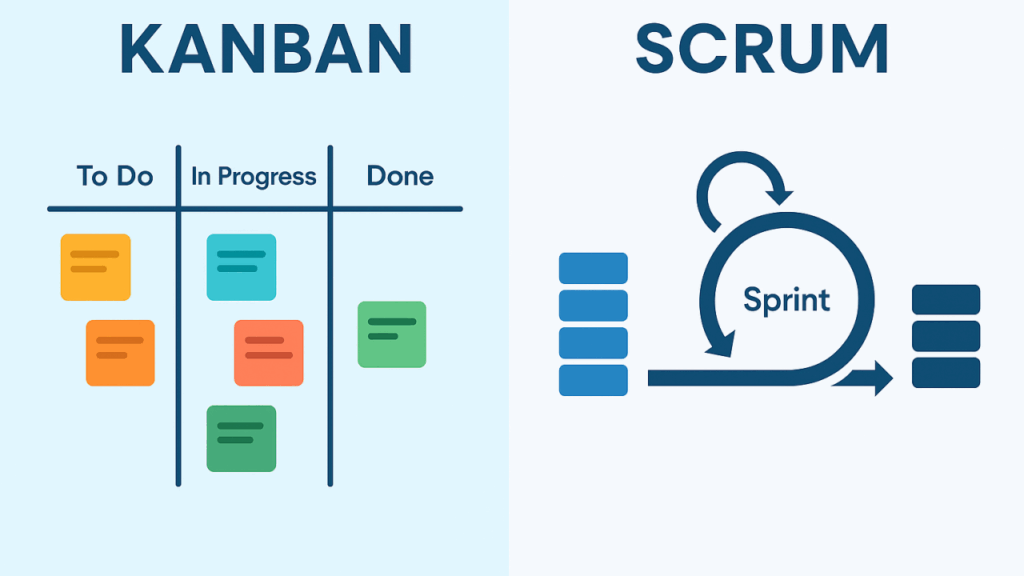
- Kanban is a continuous flow method focused on visualising tasks on a board and limiting work-in-progress (WIP) to optimise flow and reduce bottlenecks.
- Scrum is a time-boxed iterative framework where teams plan and commit to work in fixed cycles called sprints (usually 2–4 weeks).
In simple terms, Kanban is about managing ongoing flow, while Scrum is about delivering in structured bursts. Both share Agile essentials like transparency, collaboration, and continuous improvement, but how they implement these principles varies.
Kanban Fundamentals
Kanban centres around a visual board with columns representing workflow stages (e.g., To Do, In Progress, Done), where teams:
- Track work as cards that move across stages.
- Set limits on how much work can be in progress at once (WIP limits) to reduce overload and increase focus.
- Allow priorities to change at any time without abandoning the workflow.
This flexibility makes Kanban especially suitable for teams with unpredictable workloads — like support teams or creative operations where tasks may arrive at any moment and need quick action.
Scrum Fundamentals
Scrum introduces structure through:
- Defined roles — Product Owner, Scrum Master, and Development Team.
- Scheduled ceremonies — Sprint Planning, Daily Stand-ups, Sprint Review, and Sprint Retrospective.
- Fixed sprint cycles with commitments, which help teams predict output and foster focus.
This framework works well for teams building complex products or needing reliable cadence and measurable velocity over time.
🤔 How to Choose Between Them
There isn’t a “one-size-fits-all” answer, but here are general guidelines:
Choose Kanban if:
- You need continuous delivery without fixed timeboxes.
- Your priorities shift frequently.
- You want minimal roles and ceremonies.
Choose Scrum if:
- You benefit from structured, predictable cycles.
- You want clearly defined roles and routines.
- Your work involves building complex products with stakeholder visibility needs.
Many teams today blend elements of both — a hybrid often called Scrumban — to balance Scrum’s discipline with Kanban’s flow flexibility.
Source: Planio “Kanban vs. Scrum: Differences, benefits, and how to choose”