
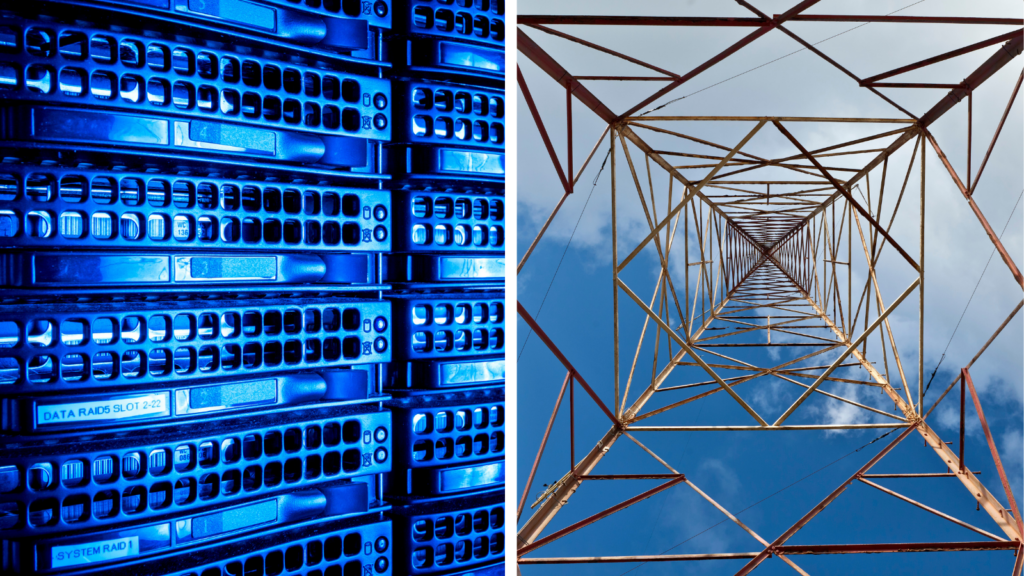
Telecom Towers vs. Data Centers: Understanding the Two Pillars of Digital Infrastructure
When we make a phone call, stream a video, open a cloud application, send a message, or interact with an AI platform, we rarely think about the physical infrastructure making that experience possible.
Behind every digital interaction is a complex ecosystem of networks, fiber, antennas, power systems, servers, cooling equipment, and connectivity infrastructure.
Two of the most important components of this ecosystem are telecom towers and data centers.
At first glance, they could not look more different.
A telecom tower rises above a city, highway, or rural landscape, carrying antennas designed to transmit wireless signals across geographic areas.
A data center is typically a highly secured facility filled with servers, storage, networking equipment, electrical systems, and cooling infrastructure.
Yet they are not competing infrastructures.
They are complementary.
A telecom tower helps connect a user to the network. A data center provides the computing, storage, applications, and digital services that the network delivers.
Understanding the difference—and the relationship—between them is essential to understanding the future of digital infrastructure.
1. Telecom Towers: Connecting the Edge
Telecom towers are fundamentally about connectivity and coverage.
They support the radio access network that connects smartphones, connected devices, businesses, vehicles, and other endpoints to mobile networks.
A typical tower site may include antennas, radios, transmission equipment, power systems, batteries, fiber or microwave backhaul, and supporting infrastructure.
The tower itself is only the visible part of a much larger network.
The GSMA describes towers and other passive infrastructure—including sites, masts, ducts, dark fiber, and power systems—as essential components supporting the active network infrastructure required for mobile communications.
The primary mission of a telecom tower is simple:
Get the signal where it needs to go.
This means providing:
Geographic coverage
Wireless connectivity
Capacity
Signal quality
Network availability
Connectivity for 4G and 5G users
Backhaul connectivity toward the wider network
For users, the tower is often the first physical infrastructure point encountered when accessing a mobile network.
2. Data Centers: Powering the Digital Core
If telecom towers connect users to the network, data centers provide much of the computing infrastructure behind the services users access.
A modern data center houses servers, storage, networking equipment, power systems, cooling systems, security infrastructure, and monitoring platforms.
According to the International Energy Agency, data centers contain servers, storage systems, networking equipment, and the supporting infrastructure required to keep this equipment operational.
This makes the data center fundamentally different from a telecom tower.
The tower is primarily concerned with moving information.
The data center is primarily concerned with processing, storing, managing, and delivering information.
Cloud computing, enterprise applications, streaming platforms, databases, AI workloads, digital services, and many other applications ultimately depend on data-center infrastructure.
And as AI adoption accelerates, the importance of this infrastructure is increasing further.
Uptime Institute’s 2026 Global Data Center Survey highlights strong demand for data centers driven increasingly by high-density and AI-related workloads, while operators face growing challenges around power availability, grid reliability, costs, supply chains, and staffing.
3. Telecom Towers vs. Data Centers: What Is the Difference?
The easiest way to understand the distinction is to look at their primary functions.
| Dimension | Telecom Towers | Data Centers |
|---|---|---|
| Primary role | Wireless connectivity | Computing, storage & digital services |
| Position in network | Edge / access | Core / processing |
| Main equipment | Antennas, radios, transmission | Servers, storage, networking |
| Main objective | Coverage & connectivity | Availability & computing performance |
| Typical environment | Outdoor / distributed | Controlled / secured facility |
| Cooling requirements | Relatively limited | Major engineering requirement |
| Power demand | Generally lower per site | Can reach very high power levels |
| Geographic footprint | Highly distributed | More centralized, regional or distributed |
| Key concern | Signal, coverage & uptime | Power, cooling, redundancy & uptime |
| Typical users | Mobile subscribers & connected devices | Applications, enterprises, cloud & digital services |
However, this comparison should not be interpreted as a strict separation.
Modern networks increasingly blur the boundary between edge and core.
4. The Most Important Difference: Their Role in the Digital Journey
Consider what happens when you open a cloud application on your smartphone.
Your device first communicates wirelessly with a nearby mobile network site.
The signal reaches the radio infrastructure.
From there, traffic moves through backhaul and transport networks.
It can then reach computing infrastructure where applications and data are processed.
The response travels back through the network to your device.
In simplified form:
Smartphone → Telecom Tower → Backhaul/Fiber → Data Center/Cloud → Backhaul/Fiber → Telecom Tower → Smartphone
This illustrates why neither infrastructure should be viewed in isolation.
A tower without a functioning network behind it cannot deliver the full digital service.
A data center without reliable connectivity cannot effectively serve distributed users.
The value comes from the entire infrastructure chain working together.
This is also the central idea highlighted in Brandon Crawford’s Medium article, “The Backbone of Connectivity: Telecom Towers vs Data Centers,” which describes towers as connecting people to the network and data centers as powering what that network delivers.
5. Why Telecom Towers Are So Important
Telecom towers have become critical infrastructure for modern society.
Mobile connectivity is no longer simply about voice calls.
Networks now support:
Mobile broadband
5G services
Internet of Things (IoT)
Connected vehicles
Smart cities
Industrial automation
Emergency communications
Remote services
Business connectivity
Real-time applications
As mobile networks expand, infrastructure must become more distributed and capable.
The GSMA notes that tower and fiber infrastructure are facing increasing complexity and bandwidth requirements as the industry moves further into the 5G era. It also identifies challenges such as rural coverage, energy efficiency, and infrastructure optimization.
This is why tower infrastructure remains strategically important even as digital services become increasingly cloud-based.
The cloud cannot reach users without a network.
And networks cannot reach users without physical infrastructure.
6. Why Data Centers Are Becoming More Important
The growth of cloud computing, streaming, digital platforms, cybersecurity, enterprise software, and artificial intelligence is transforming the role of data centers.
Data centers are no longer simply buildings filled with servers.
They are becoming critical digital infrastructure platforms.
The emergence of AI is particularly significant.
AI workloads require substantial computing capacity, high-density hardware, advanced networking, and increasingly sophisticated cooling and power systems.
The IEA notes that AI model training and deployment occur mainly in data centers, making data-center infrastructure an increasingly important part of the energy and technology ecosystem.
This creates a new engineering challenge:
More computing → more electricity → more heat → more cooling → more infrastructure.
Consequently, modern data-center development increasingly involves close coordination between:
Electrical engineering
Mechanical engineering
Civil works
HVAC
Power generation
Renewable energy
Battery systems
Network infrastructure
Fire protection
Security
Automation and controls
The data center has effectively become an industrial-scale technology facility.
7. Power: A Major Point of Difference
One of the clearest differences between telecom towers and data centers is their power profile.
A telecom site generally supports radio equipment, transmission systems, lighting, security, and other site infrastructure.
A large data center, however, may support thousands of servers together with extensive electrical and mechanical infrastructure.
Power availability can therefore become a fundamental constraint on data-center development.
Uptime Institute’s 2026 research identifies limited power availability and declining grid reliability among the major challenges currently affecting the data-center industry.
This is why the location of a data center increasingly depends not only on land and connectivity, but also on:
Where can we obtain enough reliable power?
That question is becoming strategically important for governments, utilities, developers, cloud providers, and investors.
8. Cooling: The Hidden Infrastructure
Another major difference is cooling.
Telecom towers typically operate with relatively limited thermal loads compared with large computing facilities.
Data centers are different.
Servers consume electricity, and much of that electricity ultimately becomes heat.
That heat must be removed continuously.
Traditional data centers rely heavily on air-based cooling, while high-density AI environments are driving greater interest in liquid-cooling technologies.
This means the future data center is increasingly an integration of:
Power + Computing + Networking + Cooling
rather than simply a building containing IT equipment.
9. Reliability Is Critical for Both
A telecom tower and a data center may have completely different engineering requirements, but they share one fundamental objective:
Availability.
Users expect connectivity to work.
Businesses expect applications to remain accessible.
Cloud platforms cannot simply stop operating because a component has failed.
For this reason, redundancy and resilience are central principles in digital infrastructure.
At telecom sites, resilience can involve batteries, generators, redundant transmission paths, multiple network connections, and robust physical infrastructure.
At data centers, redundancy can extend across power feeds, UPS systems, generators, cooling systems, network paths, servers, storage, and entire facilities.
Uptime Institute research has repeatedly highlighted the financial and operational consequences of data-center outages, with power failures among the leading causes of major public service outages tracked in its research.
In both environments, the philosophy is similar:
Design for failure before failure happens.
10. The Rise of Edge Computing: Where Towers and Data Centers Meet
Perhaps the most interesting development is that the traditional separation between telecom towers and data centers is becoming less clear.
This is happening because some applications cannot afford the latency associated with sending every piece of data to a distant centralized facility.
Consider:
Autonomous systems
Industrial automation
Augmented reality
Real-time video analytics
Smart factories
5G applications
IoT
Mission-critical applications
These applications can benefit from computing resources located closer to the user or device.
This is the concept behind edge computing.
Uptime Institute describes edge computing as distributing computing and storage capabilities toward the edge of the network, including locations such as carrier points of presence, cell towers, factories, and smart buildings.
In some architectures, computing infrastructure can therefore exist very close to telecom infrastructure.
This creates a new model:
Connectivity + Computing + Low Latency
The telecom network provides the connection.
The edge facility provides local processing.
The centralized data center provides larger-scale computing and storage.
Together, they create a more distributed digital infrastructure architecture.
11. The Future Is Not Telecom Towers vs. Data Centers
The title of the debate may suggest that organizations need to choose between towers and data centers.
They don’t.
The future is about integration.
As digital demand grows, the relationship between connectivity and computing becomes increasingly important.
More connected devices create more traffic.
More traffic creates greater demand for network capacity.
More digital applications create more demand for computing.
More AI creates greater demand for high-density data centers.
And real-time applications create greater demand for computing closer to users.
This produces a continuous infrastructure cycle:
More Connectivity → More Data → More Computing → More Infrastructure → More Connectivity
The ecosystem becomes increasingly interconnected.
12. Why This Matters for Infrastructure Investment
For developers, investors, governments, telecom operators, cloud providers, and infrastructure companies, the distinction between these assets is strategically important.
A telecom tower investment is primarily an investment in network reach and connectivity.
A data-center investment is primarily an investment in computing capacity and digital services.
But both are increasingly part of the same digital infrastructure investment landscape.
The infrastructure required to support the digital economy is becoming broader:
Towers → Fiber → Networks → Edge Sites → Data Centers → Cloud → AI
Each layer depends on the others.
This also explains why infrastructure planning can no longer happen in isolated sectors.
Energy planning, telecommunications planning, data-center development, fiber deployment, and urban development increasingly need to be coordinated.
13. The Bigger Picture
The digital world may appear virtual, but its foundations are remarkably physical.
Every video call depends on antennas, fiber, switches, servers, power systems, and cooling.
Every cloud application depends on physical machines.
Every 5G connection depends on physical network infrastructure.
Every AI service ultimately depends on computing facilities consuming electricity and generating heat.
The digital economy therefore rests on an enormous physical infrastructure ecosystem.
And two of its most recognizable components are telecom towers and data centers.
Telecom towers connect people and devices to the digital world.
Data centers provide the computing and storage that make digital services possible.
Neither replaces the other.
They work together.
Conclusion: One Connects the World. The Other Powers It.
Telecom towers and data centers represent two different sides of the same digital infrastructure ecosystem.
The tower reaches outward.
The data center powers inward.
The tower provides connectivity.
The data center provides computing.
The tower operates closer to the user.
The data center operates where digital workloads are processed and stored—whether centrally or increasingly at the edge.
But the most important insight is not the difference between them.
It is their interdependence.
As 5G, cloud computing, AI, IoT, and real-time applications continue to expand, the future of digital infrastructure will depend on how effectively these systems are designed, powered, connected, and operated together.
The question is no longer:
“Telecom towers or data centers?”
The better question is:
“How do we build the infrastructure ecosystem that allows both to work together at scale?”
Because ultimately:
Telecom towers connect the world.
Data centers power the digital experiences that run on it.
And the future of connectivity depends on both.
Sources used: Brandon Crawford’s original Medium article, alongside research and industry material from the IEA, GSMA, and Uptime Institute. The article above is an original synthesis rather than a reproduction of the source material